
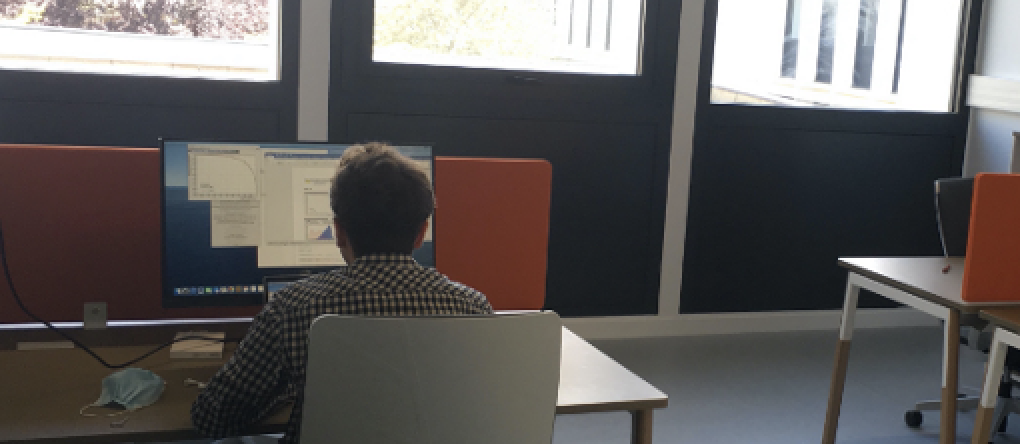
Interns are welcome !
Every year the L2IT offers a limited number of internships (stages) to outstanding students interested in undertaking a research project in one of the research teams of the lab (particle physics, gravitational waves, nuclear physics, scientific computing and data, including AI techniques). These internships allow students to work together with leading researchers on some of the most exciting topics in fundamental physics, exposing them to the most advanced theoretical, computational, observational and instrumental methods currently used in large-scale international experiments, in particular LISA, Virgo and ATLAS.
Master students (M1 and M2) and students at écoles d’ingénieurs interested in a research internship at L2IT are invited to contact us (see below for the application process). Any internship at L2IT will not be automatically followed by a PhD scholarship. However, students who successfully complete a research internship at L2IT usually greatly improve their chances to be selected for a PhD programme if they decide to continue their studies. The L2IT itself offers at least one PhD position per year.
Bachelor students (L3) who have the possibility to do a short research internship as part of their curriculum of studies are also very much welcome to contact us. One ot two bachelor students per year are generally offered an internship at L2IT.
The working language for research activities at L2IT is mainly English. Students are expected to possess an acceptable level of English to apply for an internship at L2IT.
If you have any questions or need further information, please feel free to contact any member of L2IT (see list of current members).
Application process
If you are a motivated student interested to apply for a research internship at the L2IT, please send the following documents to the head of the research group in which you would like to carry out your internship (see below for names and contacts):
- a curriculum vitae;
- a document listing the results of all your university exams;
- a motivation letter (max one page).
The application dead-line to send these documents is November 15th, 2025.
Applications will be accepted until the positions are filled, but please note that a selection process will take place immediately afterwards this deadline. Few candidates will be selected for remote interviews at the beginning of December. Interviews can be held either in French or in English according to the candidate’s preference, but in any case please be prepared to have your English level tested during the interview.
Contacts & Inquiries
Please send your applications and inquiries to the following persons:
- Catherine Biscarat (catherine.biscarat@l2it.in2p3.fr) | Head of the Computing, Algorithms and Data group
- Joany Manjarres (joany.manjarres@l2it.in2p3.fr) | Head of the Particle Physics group
- Guillaume Scamps (guillaume.scamps@l2it.in2p3.fr) | Head of the Nuclear Physics group
- Nicola Tamanini (nicola.tamanini@l2it.in2p3.fr) | Head of the Gravitational Waves group
Examples of internship projects
Here are some examples of internship research projects currently offered at L2IT. Please do not hesitate to mention one or more of these projects in your application if you are interested in them. For more information please feel free to contact members of the L2IT.
- Accelerating GNN Inference with JAX for object reconstruction at the world’s most powerful particle collider
Computing, Algorithms and Data team, → more information - Simulation-Based Inference for Overlapping Gravitational-Wave Signals
Computing, Algorithms and Data team, → more information - Generative AI Models for Denoising and Glitch Mitigation in LISA Data
Computing, Algorithms and Data team, → more information - How do black holes merge together?
Gravitational Waves team, → more information - How beyond GR merger-ringdown affect the inspiral phase of Gravitational Waves?
Gravitational Waves team, → more information - Exploring the impact of spin precession on higher-order modes in LISA observations of massive black-hole binaries
Gravitational Waves team, → more information - Exploring the impact of prior constraints on LISA observations of galactic binaries
Gravitational Waves team, → more information - Detecting superposed massive black hole signals with LISA
Gravitational Waves team, → more information - A GUEST for LISA: exploring synergies between interferometric and satellite tracking space missions for gravitational waves
Gravitational Waves team, → more information - Accelerating Charged Particle Track Reconstruction at the HL-LHC with Deep Learning
Particle Physics team, → more information
Details on the above listed subjects
| Computing, Algorithms and Data
Accelerating GNN Inference with JAX for object reconstruction at the world’s most powerful particle collider
From 2029 onward, the Large Hadron Collider (LHC) at CERN will enter its High-Luminosity phase, increasing collision rates by more than an order of magnitude. To cope with this data flow, new reconstruction algorithms are needed to track particles in detectors such as ATLAS with high precision and speed. Graph Neural Networks (GNNs) have shown excellent potential for this task, but their large-scale deployment requires highly efficient inference.
L2IT is a key contributor to the development of a GNN-based reconstruction prototype for the ATLAS experiment. This internship aims to reimplement the existing PyTorch model in JAX and benchmark its inference performance across different hardware architectures. The work will involve retraining or transferring pre-trained weights, validating numerical consistency, and assessing speed and scalability. The internship will assess JAX performance on GNNs in comparison with a Nvidia TensorRT-optimized PyTorch baseline.
The student will gain hands-on experience with JAX, deepen its understanding of advanced neural network architectures such as GNNs, and work in close collaboration with international partners, including researchers from the Lawrence Berkeley National Laboratory.
The position is open to Master’s students in computer science, applied mathematics, or engineering with a good knowledge of Python and deep learning frameworks. The internship will take place at L2IT in Toulouse, France, for six months, with a flexible start date between January and March 2026.
Supervisors: S. Caillou
Simulation-Based Inference for Overlapping Gravitational-Wave Signals
The direct detection of gravitational waves (GWs) by the LIGO–Virgo Collaboration in 2015 opened a new observational window on the Universe and marked the birth of gravitational-wave astronomy.
Next-generation gravitational-wave (GW) observatories such as Einstein Telescope and Cosmic Explorer will achieve unprecedented sensitivities, detecting thousands of compact binary coalescence events annually. This sensitivity introduces a critical challenge: overlapping signals from concurrent events that current analysis pipelines cannot efficiently process.
Traditional Bayesian parameter estimation requires O(days) of computation per event, making real-time multi-messenger astronomy coordination impossible. Furthermore, existing matched-filtering and deep-learning methods typically handle only 1-2 concurrent signals, offering limited adaptability to the crowded detector data expected in next-generation facilities.
Recent breakthroughs address these bottlenecks independently: DINGO (Dax et al., 2021) uses neural networks as surrogates for Bayesian posteriors, reducing inference time from days to minutes while maintaining full accuracy on LIGO-Virgo events. UnMixFormer (Zhao et al., 2024) employs attention-based architectures to separate and count up to 5+ overlapping GW signals with 99.89% accuracy. Combining these approaches represents a promising and unexplored direction for real-time analysis of complex multi-signal scenarios.
The intern will develop an integrated deep learning framework that performs real-time parameter estimation on overlapping gravitational-wave signals by combining signal separation with neural posterior estimation.
→ more information
Supervisors: S. Caillou, A. Rasamoela
Contacts: sylvain.caillou@l2it.in2p3.fr,antsa.rasamoela@l2it.in2p3.fr
Generative AI Models for Denoising and Glitch Mitigation in LISA Data
The Laser Interferometer Space Antenna (LISA) will open a new observational window in the millihertz gravitational-wave (GW) band, allowing the detection of signals from massive black-hole binaries (MBHBs) and thousands of galactic binaries. However, LISA’s data will also contain non-Gaussian noise artifacts (‘glitches’) that can obscure or distort astrophysical signals. Traditional denoising and glitch mitigation techniques—largely designed for ground-based detectors—are not well adapted to the continuous and overlapping signal regime expected for LISA.
Recent advances in diffusion-based generative models—notably the Denoising Diffusion Restoration Model (DDRM) and the Diffiner architecture—have demonstrated remarkable performance in removing structured noise in complex, real-world signals (e.g., speech, audio, images). Adapting these methods to gravitational-wave strain data represents a promising and unexplored direction.
The intern will explore the application of diffusion-based generative models to denoise and restore LISA strain data affected by instrumental glitches and overlapping MBHB signals. The project will involve both methodological development and experimental validation on simulated datasets.
→ more information
Supervisors: A. Rasamoela
| Gravitational Waves
How do black holes merge together?
Gravitational waves offer us an extraordinary way to answer this question. These ripples in spacetime allow us to trace the lives of black holes, from their birth to their dramatic collisions. Different astrophysical processes are expected to leave unique signatures in the population we observe today, giving us valuable clues about how these extremes objects form and evolve. With the growing number of gravitational-wave detections, we now have enough data to begin uncovering these hidden patterns.
In this project, the student will learn the state-of-the-art tools used by the gravitational-wave community to study black hole populations and will work on developing new methods to distinguish between different subpopulations using current observations. This research lies at the intersection of gravitational-wave physics, black hole astrophysics, and Bayesian data analysis, offering an exciting opportunity to dive into one of the most dynamic areas of modern astrophysics.
Supervisors: V. Gennari and N. Tamanini
How beyond GR merger-ringdown affect the inspiral phase of Gravitational Waves?
Gravitational Waves (GWs) are typically described by three main phases. The inspiral phase occurs when two compact objects orbit each other at relatively low velocities, allowing the system to be accurately modelled using Post-Newtonian (PN) expansions, which provide perturbative corrections to Newtonian gravity. The merger phase follows, representing the most nonlinear and complex stage of the coalescence. As the two bodies approach and merge into a single, highly distorted black hole, strong-field relativistic effects dominate, and accurate modelling requires numerical relativity simulations. Finally, the ringdown phase describes the relaxation of the newly formed black hole into a stable, stationary state. The emitted radiation consists of quasi-normal modes whose frequencies and damping times depend only on the black hole’s mass and spin, in agreement with the no-hair theorem. Deviations from these expected modes could signal new physics beyond General Relativity (GR).
As LISA will be the first space-based detector capable of observing Massive Black Hole Binaries across cosmological distances, it offers an unprecedented opportunity to test GR with high precision. A key question arises: if the merger and ringdown phases deviate from GR, how would this affect inspiral-based tests of the theory? Understanding whether non-GR behavior in the late stages can bias or contaminate GR tests based solely on the inspiral is essential for assessing the robustness of future LISA analyses.
Supervisors: M. Piarulli and S. Marsat
Exploring the impact of spin precession on higher-order modes in LISA observations of massive black-hole binaries
Massive black hole binaries (MBHBs) are among the most promising sources detectable by the future space-based observatory LISA, offering a unique opportunity to study how these systems form and evolve within their host galaxies. The gravitational-wave (GW) signals from these binaries consist of a dominant quadrupole mode and additional higher-order modes, whose relative strength depends on the intrinsic parameters of the source.
In this project, we will use state-of-the-art GW models and simulated LISA data to explore how spin precession, driven by the spin magnitude and tilt angle of the individual black holes, affects the detectability of higher modes. We will identify the regimes where these modes contribute significantly and study their potential impact on the characterization of source properties. By investigating these effects, the project will aim to provide a better understanding of the role higher-order modes play in shaping the MBHB signals observable by LISA.
Supervisors: A. Spadaro, S. Marsat and/or J. G. Baker
Exploring the impact of prior constraints on LISA observations of galactic binaries
Stellar binaries within our galaxy, composed primarily of double white dwarf (DWD) systems, are expected to comprise the most numerous individually measurable sources observed by the Laser Interferometer Space Antenna (LISA). LISA observations of some galactic binaries are also expected to be cleanly associated with electromagnetically observed DWD systems, including several that are already known. Incorporating prior information from associated observations together with LISA’s data can generally improve the precision of Bayesian inference results from the combined observation. This project will investigate the value of various features of electromagnetic DWD constraints in joint inference analysis with LISA to understand the degree to which different kinds of information are likely to contribute significantly.
Supervisors: J. G. Baker
Detecting superposed massive black hole signals with LISA
The future space detector LISA (Laser Interferometer Space Antenna) will detect gravitational wave signals from numerous sources in the mHz frequency band. In particular, signals from Massive Black Hole Binaires (MBHBs) form one of the main scientific targets of LISA. The purpose of this internship is to explore the detection and separation of MBHB signals in a realistic setting. These signals will be superposed with each other, slowly emerging from the noise and ending with a loud merger when the two black holes coalesce. In this project, we will investigate how the superposition of nearby merger signals can affect the data analysis, and how the quiet, early inspiral part of the signals can be recovered in advance of the coalescence when superposed signals are taken into account.
Supervisors: S. Marsat
A GUEST for LISA: exploring synergies between interferometric and satellite tracking space missions for gravitational waves
The Gravitational Universe Exploration with Satellite Tracking (GUEST) is a proposed space mission aimed at detecting gravitational waves (GWs) around 0.1 mHz. GUEST will consist of two spherical, high-density satellites covered by laser reflectors, laser-tracked by ground stations to accurately reconstruct the orbits. Among the GW sources that GUEST aim at detecting are massive black hole binaries (MBHBs) at few years from their merger, when the Laser Interferometer Space Antenna (LISA) space mission will observe their GW signal with high accuracy.
This internship project will investigate synergies between GUEST’s and LISA’s observations of MBHBs. The intern will use numerical codes to analyse simulated GUEST and LISA data in order to assess the joint detectability of MBHBs and characterise their parameters. A particular emphasis will be given to possible improvements on the sky-localisation of MBHBs to boost multi-messenger opportunities.
The intern will acquire first hand experience with data analysis codes in the context of GW space missions, expertise on advanced statistical methods applied to fundamental physics, and deep knowledge of GW science and its and multi-messenger implications.
Supervisors: N. Tamanini
| Particle Physics
Accelerating Charged Particle Track Reconstruction at the HL-LHC with Deep Learning
In 2030, the Large Hadron Collider at CERN (Geneva, Switzerland) will start its high-luminosity phase (HL-LHC), with a tremendous increase in the number of simultaneous proton-proton collision. The ATLAS experiment will install a new inner detector, the ITk, to keep excellent charged particle trajectory (track) measurement capabilities in such extreme conditions. To cope with the resulting large increase of the data rate, the ATLAS experiment is pursuing several methods to reduce resource consumption, including approaches based on Machine Learning as those developed at the L2IT.
L2IT is a key contributor to the development of a track reconstruction prototype based on Graph Neural Network (GNN). Promising performance on track finding have already been demonstrated. Extending this method to include track fitting with new methods, such as Transformers, is of great interest. Finding the track candidates but also measuring the track parameters, such as the momentum and impact parameters, will streamline the whole process and make it even faster and more accurate.
This will pave the way to a more integrated chain of track reconstruction and b-quark jet identification, of uttermost importance to detect Higgs pair production and measure the Higgs boson self-coupling.
This internship aims to add the capabilities of track parameter evaluation in the GNN-based track reconstruction pipeline developed for the ATLAS experiment. The student will gain expertise in both track reconstruction in a High Energy Physics experiment and Deep Learning technics. If time allows, application to the HH -> bbgammagamma signal at HL-LHC will be studied.
The position is open to Master’s students in particle physics. The internship will take place at L2IT in Toulouse, France, for six months, with a flexible start date between February and March 2026. This work may lead to further studies during a PhD Thesis.
Supervisors: S. Caillou (Ingénieur de Recherche CNRS) and A. Vallier (Chargé de Recherche CNRS)
Contact: alexis.vallier@l2it.in2p3.fr
